Making advanced catalyst materials in milliseconds
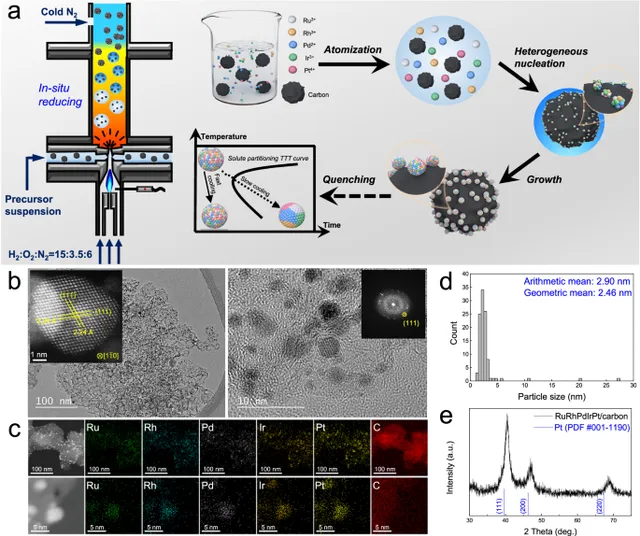
A flame aerosol process rapidly forms high-entropy alloy nanoparticles, opening new ways to explore catalyst compositions for energy applications.
Coverage & paperRESEARCH & COLLABORATION
Stories behind the science—from computational discovery to collaborative advances in materials and energy.
Explore the coverage archive
A flame aerosol process rapidly forms high-entropy alloy nanoparticles, opening new ways to explore catalyst compositions for energy applications.
Coverage & paper
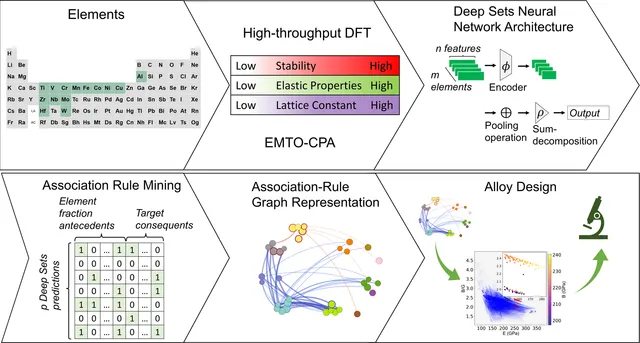
High-throughput quantum calculations and Deep Sets learning connect alloy composition with stability and elastic properties, helping guide the search for new materials.
Coverage & paper
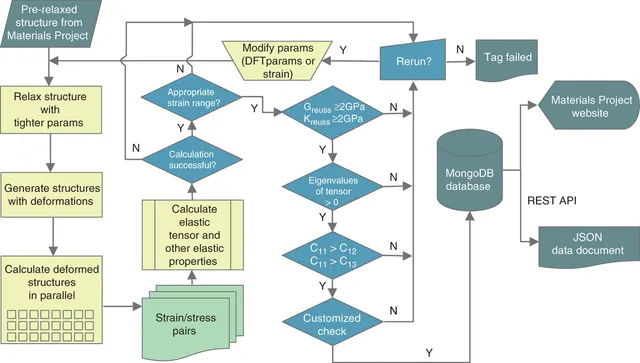
First-principles calculations deliver complete elastic tensors for more than 1,000 inorganic compounds, helping researchers screen materials for mechanical performance.
Coverage & paperCOVERAGE ARCHIVE
Last updated September 29, 2026
8 research stories · 13 coverage links
A flame aerosol process rapidly forms high-entropy alloy nanoparticles, opening new ways to explore catalyst compositions for energy applications.
Collaborative work with Mark Swihart, Chaochao Dun, and a multi-institution team. UB identifies Haolan Sun and Wei Chen among the Materials Design and Innovation contributors.
A reusable polyoxoniobate material captures magnesium from brine while leaving lithium in solution, connecting selective separation with recovery of both resources.
Coauthored research with Linfeng Chen, Chenyang Li, Chaochao Dun, Jeffrey Urban, and collaborators. The study combines structural, spectroscopic, and computational analysis.
Iron phosphate particle size helps determine how selectively electrodes capture lithium rather than sodium, informing materials design for extraction from dilute solutions.
Research led by Chong Liu and Gangbin Yan, with Jialiang Wei and Wei Chen among the coauthors from Illinois Tech, alongside UChicago and Argonne collaborators.
High-throughput quantum calculations and Deep Sets learning connect alloy composition with stability and elastic properties, helping guide the search for new materials.
TACC interviews Wei Chen as the study’s senior author. The work brings together Jie Zhang and George Kim at Illinois Tech with Chen Cai and Yusu Wang at UC San Diego.
Oxygen-functionalized copper nanoparticles improve methane selectivity in a solar-powered carbon dioxide conversion system.
Coverage of Mohammad Asadi’s research team. The paper credits Wei Chen and Jialiang Wei with the density functional theory calculations that help explain catalyst activity and selectivity.
A joint computational and experimental screening approach identifies promising metal-vanadate photoanodes for converting sunlight into chemical fuels.
Wei Chen coauthored the associated PNAS paper with the Caltech and Berkeley Lab team. The news feature focuses on work led by John Gregoire, Jeffrey Neaton, Kristin Persson, and Qimin Yan.
Automated calculations map piezoelectric properties across nearly 1,000 inorganic compounds, creating an open resource for discovering useful crystal responses.
Coauthored with Maarten de Jong, Henry Geerlings, Mark Asta, and Kristin Persson. Berkeley Lab and Illinois Tech identify Wei Chen as a member of the research team.
First-principles calculations deliver complete elastic tensors for more than 1,000 inorganic compounds, helping researchers screen materials for mechanical performance.
Berkeley Lab identifies Maarten de Jong and Wei Chen as the two lead authors, working with Mark Asta, Kristin Persson, and a broader international team.
This archive brings together verified research coverage found to date. Reports about the same study are grouped together; institutional republications are identified alongside their sources. Featured figures are reproduced in full, with only display size and file format optimized.